
Industrial emissions regulations are becoming an increasingly important factor in investment decisions, plant design and international growth strategies.
There is, however, one major challenge that companies operating across different markets need to consider: there is no single global framework for industrial emissions.
Emission limits, permitting procedures, monitoring requirements and applicable control technologies can vary significantly from one country to another and, in some cases, between different states or regions within the same country.
For companies operating internationally, environmental compliance therefore means more than installing an emissions control system. It means designing a solution that is consistent with the industrial sector, production process, pollutants involved and regulatory framework applicable in the country where the plant will operate.
This guide compares the main approaches adopted in Europe, the United States, China and India, focusing on industrial air emissions regulations, Best Available Techniques (BAT), European mechanisms such as the IED, ETS and CBAM, and the implications these differences have for industrial emissions control plant design.
Why industrial emissions regulations are becoming increasingly important
Industrial emissions control is no longer simply about meeting a legal concentration limit.
Environmental regulation has progressively moved towards a broader approach that considers not only pollutant concentrations, but also process efficiency, resource consumption, pollution prevention and the ability of industrial installations to adapt to future requirements.
This has an important consequence for manufacturers: environmental compliance should be considered from the earliest stages of plant design.
An emissions control system designed only to meet today’s requirements may become inadequate when emission standards change, production capacity increases or the company enters a new market.
For this reason, regulatory assessment should come before technology selection.
The question should not simply be:
“Which technology allows us to meet the current limit?”
but rather:
“Which solution allows us to meet current requirements while maintaining sufficient compliance margin over time?”
This distinction is particularly important for industrial plants designed to operate for many years.
Industrial emissions regulations in Europe
The European Union has developed one of the world’s most structured approaches to preventing and controlling industrial pollution.
The European framework combines environmental permitting, pollution prevention, technology requirements, resource efficiency and monitoring.
One of its main regulatory instruments is the Industrial and Livestock Rearing Emissions Directive (IED 2.0). The revised Directive 2010/75/EU was amended by Directive 2024/1785 and entered into force on 4 August 2024.
IED 2.0 aims to reduce the environmental and health impacts of large industrial installations by addressing emissions to air, water and land, while also strengthening resource efficiency, decarbonisation and technological innovation.
IED and environmental permitting
A key feature of the European approach is the relationship between regulation, permitting and technology.
Environmental permits are issued by the competent authorities in EU Member States, while Best Available Techniques (BAT) play a central role in defining permit conditions.
BAT refers to the most effective techniques that are technically and economically viable for preventing or reducing environmental impacts from industrial activities.
At European level, the BAT process leads to the development of BREF – Best Available Techniques Reference Documents, which support the development of
BAT Conclusions and, ultimately, many of the conditions incorporated into environmental permits.
For industrial emissions control projects, this means that technology selection cannot be separated from the applicable permitting framework.
BAT as an increasingly international concept
BAT is not exclusively a European concept.
The OECD has analysed BAT-based policies across several jurisdictions, including the European Union, the United States, China and India, highlighting significant differences in how BAT principles are incorporated into national regulatory systems.
For international companies, this means that BAT can provide a useful technical and regulatory reference, but BAT compliance in one jurisdiction does not automatically guarantee compliance in another.
ETS and CBAM: European regulations to know
European environmental regulation is not limited to conventional air pollutants.
Greenhouse gas emissions and carbon-related mechanisms are also becoming increasingly relevant to industrial companies.
The EU Emissions Trading System (EU ETS) is Europe’s carbon market. It places a price on greenhouse gas emissions and creates an economic incentive for companies to reduce them.
The Carbon Border Adjustment Mechanism (CBAM) complements the EU ETS and entered its definitive regime on 1 January 2026. It introduces a carbon adjustment mechanism for certain categories of goods imported into the European Union and aims, among other objectives, to address the risk of carbon leakage.
CBAM currently covers categories including cement, iron and steel, aluminium, fertilisers, electricity and hydrogen. Importers subject to the definitive regime have specific obligations concerning embedded emissions and CBAM certificates.
For international manufacturers, this means that emissions compliance can increasingly affect commercial competitiveness as well as environmental costs.
Industrial emissions regulations in the USA
The United States has a fundamentally different regulatory structure.
There is a strong federal framework, but state-level requirements can play a significant role in how environmental regulations are implemented.
The main federal reference is the Clean Air Act (CAA), which regulates air emissions from stationary and mobile sources.
The US Environmental Protection Agency (EPA) develops and implements numerous air pollution control programmes. The Clean Air Act provides, among other things, for National Ambient Air Quality Standards (NAAQS) and state implementation plans (SIPs).
This makes the US system structurally different from the European model.
NESHAP and NSPS
Several regulatory mechanisms apply to industrial stationary sources.
NESHAP – National Emission Standards for Hazardous Air Pollutants establish requirements for hazardous air pollutants and, for major sources, are associated with Maximum Achievable Control Technology (MACT) standards.
NSPS – New Source Performance Standards, on the other hand, apply to specific categories of new, modified and reconstructed sources and are designed to ensure appropriate emissions control technologies as industrial infrastructure evolves.
The EPA organises air pollution requirements by industrial sector, including NESHAP, NSPS and other regulatory programmes for combustion sources, refineries, engines and other industrial processes.
The role of individual states
For companies planning to install industrial equipment in the United States, federal requirements are therefore only part of the assessment.
The analysis should also consider the state, local authority, source category, production process and characteristics of the area where the facility will operate.
As a result, two apparently identical industrial plants may face different requirements depending on their location.
Industrial emissions regulations in China
China has progressively developed a more structured framework for controlling industrial emissions.
The Ministry of Ecology and Environment (MEE) publishes emission standards for different industrial sectors and stationary sources.
The catalogue of stationary-source emission standards includes requirements for sectors such as chemicals, petroleum refining, non-ferrous metals, ceramics, batteries and several other industrial activities.
The strong sector-specific component of the Chinese framework is particularly relevant when assessing plant compliance.
It is therefore not enough to know the general emission limit for a pollutant. Companies need to determine which standard applies to the specific process and emission source.
As standards and enforcement mechanisms continue to evolve, plant designers should also consider sufficient technological margin rather than designing an emissions control system exclusively around the minimum requirement applicable at the time of investment.
Industrial emissions regulations in India
India is also progressively strengthening its industrial emissions control framework.
The Central Pollution Control Board (CPCB) plays an important role in developing and updating standards for emissions and discharges from industrial activities.
The Indian system has a strong sector-specific component, with technical and institutional review processes involved in the development and adoption of industrial standards.
For companies operating in India, regulatory assessment therefore needs to consider the specific industrial activity, emission source and location of the plant.
India’s continued industrial development also makes the ability of industrial facilities to adapt to increasingly stringent environmental requirements an important consideration for long-term investment decisions.
Europe, the USA, China and India: where are industrial emission limits the strictest?
A common question is:
Which country has the strictest industrial emissions regulations?
There is no simple global ranking.
Regulatory stringency depends on the pollutant, industrial sector, plant size, emission source, measurement methodology and permitting framework.
A more useful comparison is therefore to look at the overall regulatory approach.
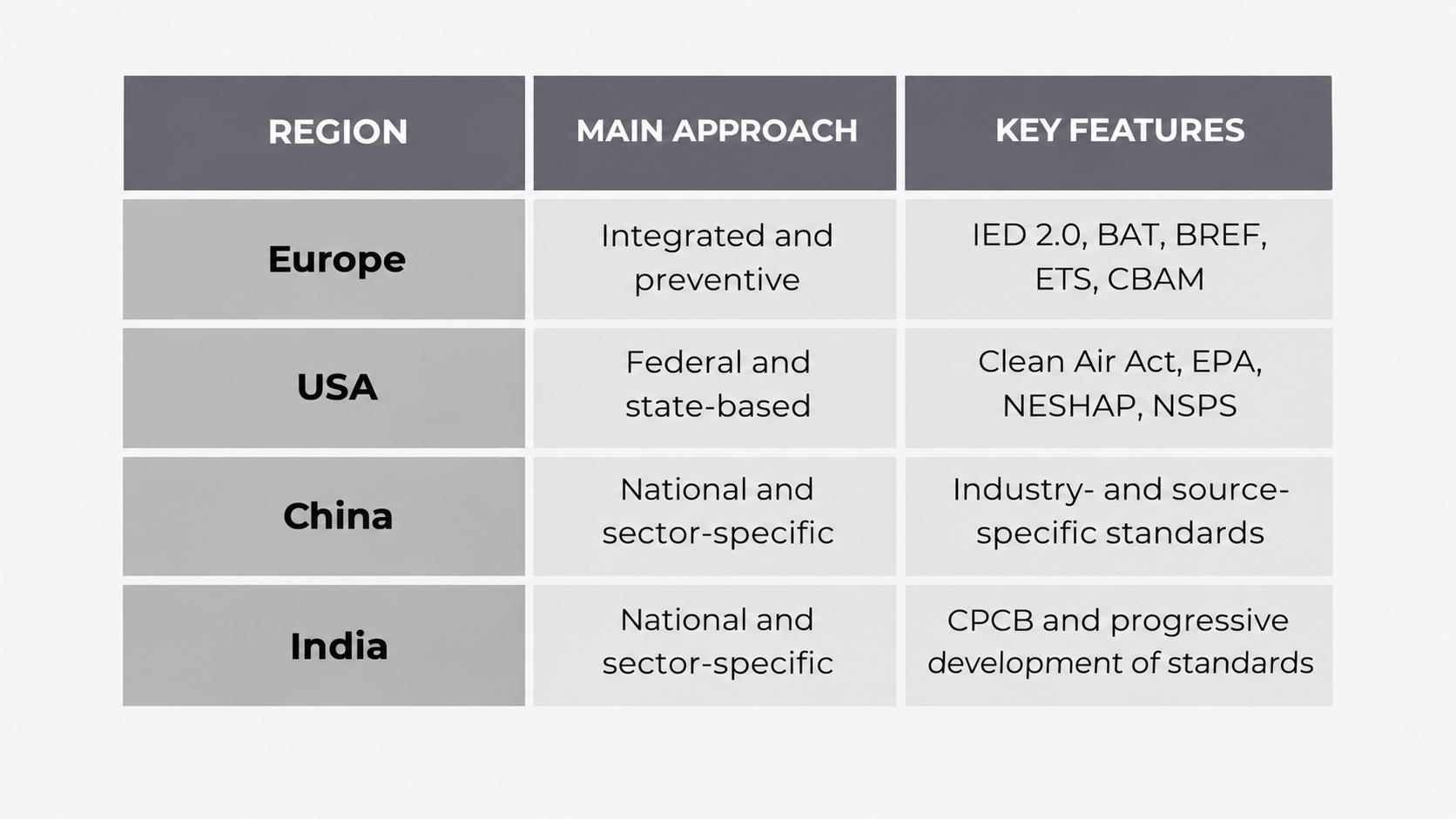
The differences become particularly important for companies designing and supplying industrial emissions control systems internationally.
The OECD has carried out cross-country comparisons of BAT and industrial pollution control approaches, including sectors such as thermal power generation, cement, textiles, iron and steel, pulp and paper and waste incineration.
Why a compliant plant in one country may not be compliant in another
This is one of the most important issues when designing industrial emissions control systems for international markets.
Consider an emissions treatment system designed to achieve a specific emission level.
The fact that the system meets the applicable limit in Country A does not automatically mean that it will be compliant in Country B.
The reason is straightforward: the parameters determining compliance can be different.
Emission limits may vary, as can regulated pollutants, operating conditions, sampling and measurement methods, monitoring requirements, permitting procedures and source classifications.
Even where two countries use similar concepts, such as BAT or technology-based standards, these concepts may be incorporated differently into national permitting systems. OECD comparative research confirms significant differences between regulatory approaches in Europe, the USA, China, India and other jurisdictions.
For this reason, an international industrial emissions control project should begin with a regulatory assessment.
Before selecting the technology, the project should consider:
- production process;
- emission flow rate and composition;
- pollutants to be treated;
- applicable emission limits;
- operating conditions;
- monitoring requirements;
- permitting requirements;
- foreseeable future regulatory requirements.
Only after these parameters have been established can the most appropriate technology be selected. Depending on the application, this may include adsorption systems, scrubbers, regenerative thermal oxidizers, filtration systems or integrated treatment solutions.
Compliance is not only an obligation: it is a competitive advantage
Treating environmental regulations only as a constraint means overlooking their strategic value.
For an industrial company, designing a plant with sufficient flexibility and technological margin can reduce the risk of future modifications, production downtime and costly regulatory upgrades.
This is particularly relevant for companies exporting industrial plants and equipment.
A system designed with international requirements in mind can provide greater flexibility than a solution developed exclusively to meet the minimum requirements of a single market.
Compliance therefore becomes part of the Total Cost of Ownership of an industrial plant.
The real cost of a solution is not limited to its purchase and installation. It also includes energy consumption, maintenance, future modifications, production downtime and the costs associated with regulatory upgrades.
For a deeper analysis of this topic, this pillar page should link to: “Industrial compliance strategy: why anticipating regulations costs less than chasing them”
Industrial emissions regulations: designing for tomorrow
The international regulatory landscape will continue to evolve.
Europe, the United States, China and India use different regulatory approaches, but they share a common direction: greater attention to pollution prevention, emissions control and the environmental efficiency of industrial processes.
Compliance should therefore not be assessed only once a plant has already been designed.
It should be one of the starting criteria of the project.
For industrial companies, understanding global emissions regulations is therefore not only about avoiding penalties or permitting problems. It is also about designing plants that are more efficient, more flexible and better prepared for future regulatory and market developments.
True compliance is not about chasing the next emission limit. It is about designing today a solution that can remain competitive tomorrow.
