
- How a proactive industrial compliance strategy reduces risk, protects profitability and lowers total cost of ownership
- Why the cheapest solution is rarely the most economical
- The real cost of retrofitting industrial plants
- Why multinational companies invest ahead of regulations
- Industrial compliance strategy and total cost of ownership
- Compliance and energy efficiency: a winning combination
- Looking beyond the next regulation
How a proactive industrial compliance strategy reduces risk, protects profitability and lowers total cost of ownership
Industrial compliance strategy is no longer just a regulatory concern. For modern manufacturers, it has become a key financial lever capable of influencing profitability, operational continuity and long-term competitiveness.
When companies evaluate new industrial equipment, the purchase price is often the first parameter considered. However, focusing exclusively on initial investment can lead to decisions that appear economical today but become significantly more expensive over the lifecycle of the asset.
As environmental regulations evolve worldwide, businesses increasingly face stricter emission limits, tighter sustainability requirements and more demanding monitoring obligations. In this scenario, investing in an industrial compliance strategy from the beginning can significantly reduce future costs while protecting production continuity.
Why the cheapest solution is rarely the most economical
Many organizations still adopt a reactive approach to compliance. Equipment is selected to satisfy current legal requirements with minimal investment, while future regulatory developments are considered only when they become mandatory.
At first glance, this approach may seem financially advantageous. In reality, it often creates hidden costs that emerge years later.
When new regulations come into force, facilities operating close to existing emission thresholds frequently require substantial modifications to remain compliant.
These upgrades may involve additional treatment technologies, engineering redesign, plant modifications, permitting procedures and commissioning activities.
The financial impact extends well beyond the direct cost of the upgrade itself. Production interruptions, contractor management, engineering resources and operational inefficiencies can rapidly increase the overall cost of compliance.
What initially appeared to be a cost-saving decision can ultimately become a much more expensive investment.
The real cost of retrofitting industrial plants
One of the most underestimated aspects of industrial investment planning is retrofitting.
Retrofitting refers to the modification of existing equipment to meet updated technical, environmental or operational requirements. While often considered a technical necessity, it is primarily a financial challenge.
Integrating new environmental technologies into an existing facility is almost always more expensive than incorporating them during the original design phase. Existing layouts create physical constraints, utility systems may require adaptation and production schedules frequently need to be interrupted to allow installation activities.
As a result, retrofit projects often generate costs associated with:
- Engineering redesign
- Installation and commissioning activities
- Production downtime
- Additional permitting requirements
- Increased operational complexity
- Reduced manufacturing capacity during implementation
For facilities operating continuously, even a short production stop can represent a financial impact far greater than the original difference between a standard solution and a future-ready plant.
Why multinational companies invest ahead of regulations
Leading multinational manufacturers rarely design facilities to comply with regulations at the minimum acceptable level.
Instead, they typically adopt an industrial compliance strategy based on safety margins and long-term planning. Internal standards are often more restrictive than current legal requirements, allowing companies to adapt more easily to future regulatory changes.
This approach is not merely a matter of environmental responsibility. It is a business strategy designed to reduce operational risk, avoid unexpected capital expenditures and simplify future plant expansions.
Organizations that operate across multiple countries understand that regulations evolve continuously. Building compliance resilience into a facility from the beginning provides greater cost predictability and protects long-term profitability.
Industrial compliance strategy and total cost of ownership
The effectiveness of an industrial compliance strategy becomes particularly evident when evaluating Total Cost of Ownership (TCO).
TCO includes all costs generated by an asset throughout its operational life, not only the initial purchase price. Energy consumption, maintenance requirements, regulatory adaptations and production interruptions often represent a larger financial burden than the original investment.
For this reason, equipment with a higher upfront cost may actually deliver a significantly lower TCO.
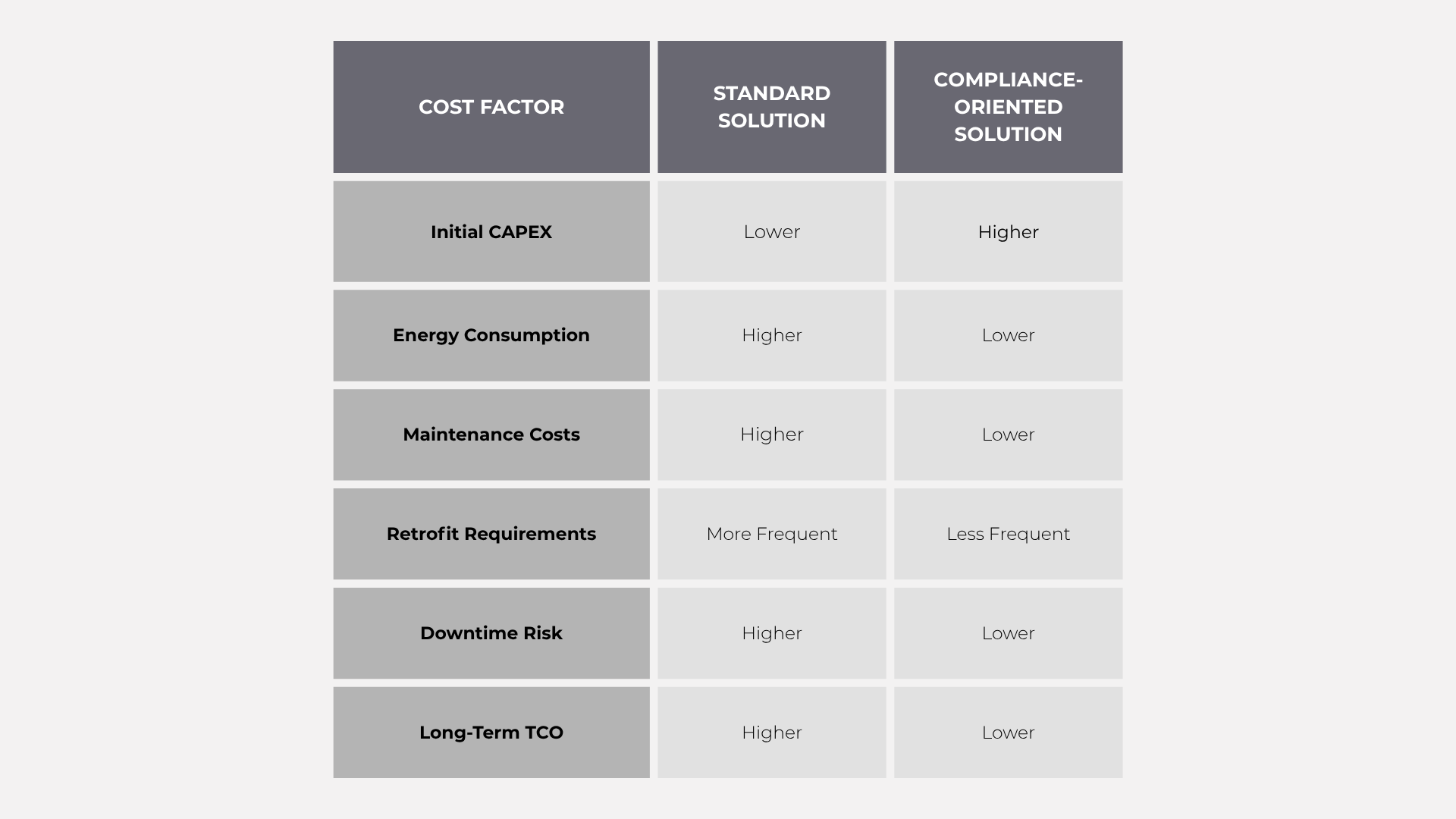
The table clearly shows why investment decisions should be based on lifecycle economics rather than acquisition cost alone.
Compliance and energy efficiency: a winning combination
A successful industrial compliance strategy should not focus exclusively on regulatory requirements. The most effective investments combine compliance readiness with energy efficiency improvements.
Technologies such as energy recovery systems, solvent regeneration plants and rotor concentrators allow manufacturers to reduce emissions while simultaneously lowering operating costs.
This combination generates a double economic benefit. Companies not only reduce regulatory risk but also improve energy performance, creating measurable savings year after year.
As energy costs continue to rise globally, these savings become increasingly important in maintaining industrial competitiveness.
In many cases, reduced energy consumption contributes significantly to the payback period of the investment, transforming environmental compliance from a cost centre into a source of long-term value creation.
Looking beyond the next regulation
Industrial regulations will continue to evolve. Environmental expectations from governments, customers and investors are becoming increasingly demanding, while energy efficiency remains a strategic priority across all manufacturing sectors.
For this reason, companies should evaluate industrial investments not only according to current requirements but also according to their ability to remain compliant in the future.
An effective industrial compliance strategy provides operational stability, reduces exposure to regulatory uncertainty and minimizes the risk of costly retrofit projects.
The most successful manufacturers are not necessarily those that spend less today. They are the ones that make investment decisions capable of protecting profitability over the entire lifecycle of their assets.
In a rapidly changing industrial landscape, anticipating regulations is no longer simply a compliance decision.
It is a strategic financial choice.
