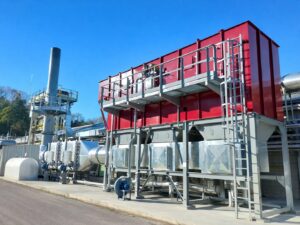
- Snapshot: the project at a glance
- The client: international leader in the production of Active Pharmaceutical Ingredients (APIs)
- The challenge: managing variable emissions, chlorinated solvents, and the risk of acid corrosion
- The solution: special electric RTO and multi-stage purification system
- Results: operational flexibility and full environmental compliance
- Frequently Asked Questions (FAQ): technologies for the treatment of chlorinated solvents
- Vai alla gallery con tutti i nostri impianti
Pharmaceutical VOC treatment and chlorinated solvents: electric RTO for a company in Switzerland
An international pharmaceutical company in Switzerland has relied on an integrated system for the management of complex emissions containing VOCs and chlorinated solvents. Discover the engineering solution based on an electric Regenerative Thermal Oxidizer (RTO), quench, and alkaline scrubber for maximum safety and regulatory compliance.
Snapshot: the project at a glance
- The Problem (Pre-intervention): The need to continuously intercept and treat variable and discontinuous VOC emissions (flow rate up to 7,250 m³/h) deriving from the production of active ingredients, with an extreme critical issue: the presence of chlorinated solvents (such as DCM) which, when burned, generate highly corrosive hydrochloric acid (HCl).
- The Solution adopted: Design of a non-standard multi-stage plant, consisting of low-temperature condensation (-80°C), an electric Regenerative Thermal Oxidizer (RTO) for a flameless operation, and a special SS316L alloy section equipped with a quench and alkaline scrubber.
- The Result (Post-intervention): Total neutralization of acidity and guaranteed pollutant abatement in a safe and flexible environment. Final emissions comply with the strictest local regulations: non-chlorinated VOCs <20 mg/Nm³, DCM <2 mg/Nm³, and HCl <5 mg/Nm³.
The client: international leader in the production of Active Pharmaceutical Ingredients (APIs)
The company featured in this case history operates globally in the pharmaceutical sector, specializing in the development and production of APIs (Active Pharmaceutical Ingredients). The intervention was necessary as part of an expansion project for their production site in Switzerland.
Specifically, the client built a new production building to integrate spray drying technologies, solution preparation departments, API packaging areas, and tank storage. During these delicate chemical and pharmaceutical processes, a critical need emerged to safely intercept and treat the Volatile Organic Compound (VOC) emissions generated by the operations.
The challenge: managing variable emissions, chlorinated solvents, and the risk of acid corrosion
The main problem the company had to face was not limited to the simple containment of VOCs. The captured emissions were highly discontinuous, with variable pollutant loads and high peaks. However, the most critical element was the chemical composition of the gases: the mixture included methanol, acetone, ethyl acetate, isopropanol, ethanol, tetrahydrofuran (THF), and, above all, chlorinated solvents such as dichloromethane (DCM).
Thermally treating chlorinated solvents represents a significant engineering challenge: during combustion, in fact, these compounds generate hydrochloric acid (HCl), a highly corrosive substance that can severely damage the hot parts and the downstream sections of the plant.
The company therefore needed a non-standard solution, capable of managing an air flow rate of up to 7,250 m³/h, operating continuously 24 hours a day for 49 weeks a year, ensuring strict compliance with stringent Swiss emission limits (including non-chlorinated VOCs <20 mg/Nm³ and DCM <2 mg/Nm³).
The solution: special electric RTO and multi-stage purification system
A traditional thermal oxidizer would not have been suitable for coping with the chemical complexity and corrosion risks of this project. A highly customized multi-stage plant was therefore designed and supplied, consisting of the following integrated technologies:
- Low-temperature condensation: A first stage operates at -80°C to condense and preliminarily abate most of the solvent load before thermal treatment.
- Electric Regenerative Thermal Oxidizer (RTO): The heart of the plant is a special electrified RTO. This choice allowed for the management of the thermal treatment without the use of a traditional gas burner, offering optimal control in a delicate production environment.
- Anti-corrosion materials: To prevent damage caused by hydrochloric acid, the combustion chamber and the components in contact with the gases were made of special alloys, such as SS316L stainless steel, and equipped with appropriate insulation to prevent acid condensation.
- Wet neutralization: Downstream of the oxidizer, the flue gases pass through a rapid cooling system (quench) and an alkaline scrubber, which physically neutralize the hydrochloric acid before it is released into the atmosphere.
Results: operational flexibility and full environmental compliance
The engineering approach adopted made it possible to successfully overcome the limits of standard systems. Today, the client benefits from a flexible and safe plant, capable of managing the various combinations of pharmaceutical solvents originating from the new departments.
The system guarantees total compliance with stringent local environmental regulations regarding emissions, protecting both operators and the environment. The integration of an electric RTO with anti-corrosion materials and wet post-treatment has proven to be the winning strategy for definitively solving the problem of chlorinated solvents in the pharmaceutical sector.
Frequently Asked Questions (FAQ): technologies for the treatment of chlorinated solvents
How to safely and continuously manage chlorinated solvents?
The safe management of chlorinated solvents requires an integrated system consisting of regenerative thermal oxidation (RTO) technologies and wet post-treatment. This engineering approach effectively abates Volatile Organic Compounds (VOCs) and, simultaneously, neutralizes the inorganic acids generated during the combustion phase.
How to avoid corrosion damage caused by the formation of hydrochloric acid (HCl) during combustion?
To avoid hydrochloric acid corrosion, it is strictly necessary to use special materials and resistant alloys in the areas of the plant exposed to acids, such as SS316L stainless steel. It is also essential to implement a quench system and an alkaline scrubber downstream of the oxidizer to physically neutralize the acidity before emission into the atmosphere.
Why use an electric Regenerative Thermal Oxidizer (RTO)?
An electric Regenerative Thermal Oxidizer (RTO) is a plant solution that allows for the thermal treatment of emissions without requiring the use of a traditional gas burner. This technology offers optimal process control and is particularly suitable for ensuring the highest safety standards in delicate production environments, such as pharmaceutical ones.
What precise emission guarantees are provided at the end of testing to ensure total local environmental compliance?
The emission guarantees for the treatment of pharmaceutical gases in this project include maintaining non-chlorinated VOCs below 20 mg/Nm³ and tetrahydrofuran (THF) below 5 mg/Nm³. For the most critical compounds, the system ensures dichloromethane (DCM) concentrations below 2 mg/Nm³ and hydrochloric acid (HCl) below 5 mg/Nm³.