
- From CAPEX to TCO: a new decision-making model for industrial investments
- What is TCO in industrial equipment?
- CAPEX vs OPEX: understanding the real cost over time
- How to evaluate an industrial investment today
- Technologies that turn efficiency into savings
- Industry benchmarks: efficiency as a competitive advantage
- From Industry 4.0 to 5.0: a shift in priorities
- A real-world perspective
- Choosing the right partner
Industrial energy efficiency is no longer just an option: it’s a competitive advantage. The most innovative companies are moving beyond the mindset of short-term savings to focus on investments that generate long-term value.
As you read this article, you’ll discover why the true cost of a technology is measured over time.
From CAPEX to TCO: a new decision-making model for industrial investments
Industrial energy efficiency is no longer just a technical feature, it is a financial strategy.
Across global manufacturing, the way companies evaluate investments is changing. For years, decisions were driven almost entirely by CAPEX: the lower the upfront cost, the better the perceived deal. Today, that logic is increasingly incomplete.
What really determines profitability is the Total Cost of Ownership (TCO): the full cost of a machine over its entire lifecycle. And this is exactly where energy efficiency becomes decisive.
A cheaper machine that consumes more energy quickly turns into a financial burden. Conversely, a more advanced and efficient system, even if more expensive at the beginning, often proves to be the most cost-effective choice over time.
This shift reflects a broader transformation: the transition from Industry 4.0 to Industry 5.0, where performance is no longer measured only in output, but in efficiency, sustainability, and long-term resilience.
What is TCO in industrial equipment?
Total Cost of Ownership represents the sum of all costs associated with an industrial asset, from purchase to operation and beyond. It includes not only the initial investment, but also energy consumption, maintenance, operational efficiency, and the system’s lifespan.
In a global context where energy costs are volatile and often rising, this perspective becomes critical. A machine that consumes less energy every hour of operation generates continuous savings, day after day, year after year. Over time, these savings can easily outweigh the initial price difference between two technologies.
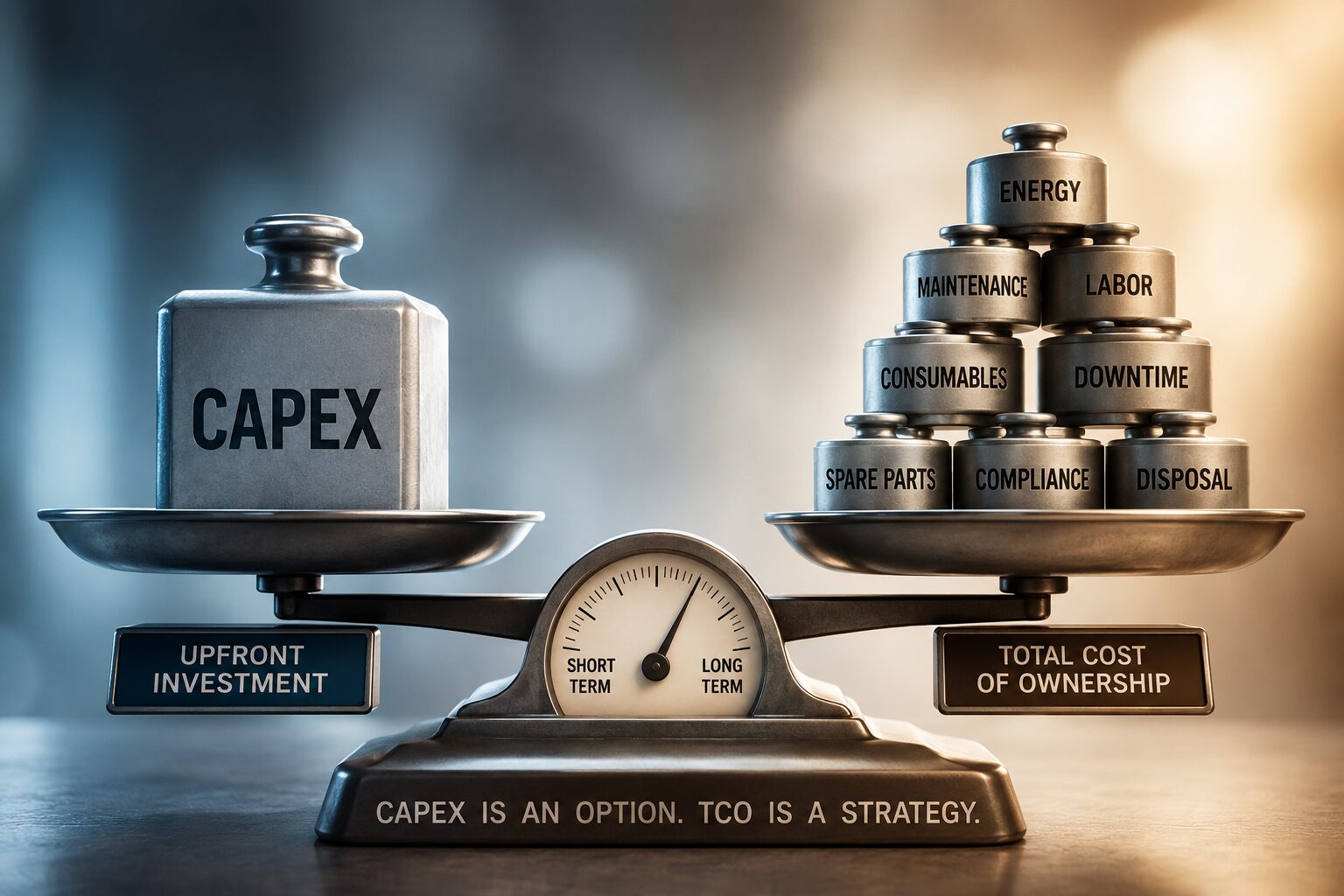
CAPEX vs OPEX: understanding the real cost over time
One of the most common mistakes in industrial procurement is focusing on what is immediately visible: the purchase price. However, the real financial impact emerges during operation.
Imagine two systems. The first requires a lower initial investment, making it attractive in the short term. The second costs more upfront but is designed to reduce energy consumption and maintenance needs. At first glance, the cheaper option seems convenient. But when energy bills and operating costs accumulate, the situation changes quickly.
Within a few years, the energy-efficient system not only compensates for the higher initial cost, but actually becomes significantly more profitable. This is the essence of a TCO-driven decision: shifting focus from immediate savings to long-term value.
How to evaluate an industrial investment today
Evaluating an industrial plant today requires a broader and more strategic approach. Energy consumption is no longer just a technical parameter—it is a financial variable that directly affects margins. The number of operating hours, the continuity of production cycles, and the system’s ability to maintain performance over time all contribute to defining its real cost.
Maintenance also plays a crucial role. Systems designed with advanced materials and optimized layouts tend to reduce downtime and intervention costs. At the same time, integrated solutions—where energy recovery and emission treatment are part of a unified design—can significantly improve overall efficiency.
Ultimately, the most effective investments are those capable of combining performance, durability, and energy optimization into a single system.
Technologies that turn efficiency into savings
Modern industrial technologies are increasingly designed to transform energy efficiency into measurable economic benefits.
Energy recovery systems, for example, allow companies to reuse thermal energy that would otherwise be wasted, reducing the need for additional fuel.
Similarly, rotor concentrators optimize air treatment processes by reducing the volume of airflow to be managed, leading to lower energy consumption.
Solvent evaporation and regeneration systems, on the other hand, enable the recovery of valuable raw materials, cutting both costs and environmental impact.
These are not just technical improvements. They are strategic tools that directly influence operating costs and, consequently, the overall profitability of the plant.
Industry benchmarks: efficiency as a competitive advantage
Across different industrial sectors, energy efficiency is becoming a key competitive factor. In automotive manufacturing, for instance, the integration of heat recovery systems has led to consistent reductions in energy consumption. In the chemical industry, optimizing emission treatment processes has delivered significant efficiency gains. In printing and packaging, solvent recovery technologies have transformed waste into reusable resources.
What emerges is a clear pattern: companies that invest in efficiency not only reduce costs, but also strengthen their position in increasingly demanding global supply chains, where ESG criteria are becoming standard requirements.
From Industry 4.0 to 5.0: a shift in priorities
Industry 4.0 introduced connectivity and automation, enabling machines to communicate and optimize production flows.
Industry 5.0 builds on that foundation but shifts the focus toward sustainability and human-centric design.
In practical terms, this means that machines are no longer evaluated only for their productivity, but also for how efficiently they use energy and resources. The goal is not simply to produce more, but to produce better-consuming less energy, reducing emissions, and ensuring long-term resilience.
This evolution is global. Whether in Europe, Asia, or North America, companies face the same challenge: reducing energy consumption to remain competitive and compliant with international standards.
A real-world perspective
Consider a manufacturing company operating in the automotive sector. By upgrading its systems with energy recovery technologies and advanced emission treatment solutions, the company was able to significantly reduce its energy consumption. Over time, this translated into measurable financial benefits, including a faster return on investment and lower operating costs.
This type of result is not exceptional—it is increasingly common among companies that adopt a TCO-driven approach. The key takeaway is simple: efficiency is not just about sustainability; it is about profitability.
Choosing the right partner
Making the right investment requires more than selecting a machine. It involves understanding the entire production process, evaluating long-term costs, and designing solutions that integrate seamlessly into existing operations.
Experienced suppliers play a crucial role in this process. Their ability to tailor solutions, optimize system design, and ensure reliable performance over time can make the difference between a good investment and a strategic one.
