- The environmental impact of naval painting processes.
- Emissions characteristics
- Depuration goals
- The solution through the process of rotoconcentration and regenerative thermal oxidation.
- The measures identified for application in the naval painting industry.
- The results achieved
- Go to the gallery with all our systems
Naval painting VOC emissions control systems
Naval painting VOC emissions represent one of the main environmental challenges in modern shipbuilding and marine coating processes. For worldwide shipbuilding and maintenance operations, Brofind® has implemented advanced VOC emission control systems for effluents generated by naval painting departments. In the naval industry, production processes include extensive surface treatment operations on ferrous materials that require protective coatings capable of resisting highly aggressive marine environments.
The application of paints on ferrous materials takes place in closed, large rooms, using solvent-based products, which are released into the work environment and extracted from special ventilation systems both during the application phase and during the subsequent one of drying or withering; emissions into the atmosphere therefore contain Volatile Organic Compounds (V.O.C.) and dust generated by the paint fractions (overspray) that failed to settle on the part to be painted and which can be emitted into the surrounding environment generating olfactory nuisance and environmental pollution.
Without dedicated treatment technologies, these pollutants may significantly impact air quality and environmental compliance.
According to the European Environment Agency, VOC emissions are among the main contributors to industrial air pollution and ozone formation.
Emissions characteristics
Atmospheric emissions deriving from naval painting processes have the following characteristics:
| VARIABLE | CHARACTERISTICS |
|---|---|
| Temperature | Room |
| Presence of volatile organic compounds (V.O.C.) | Aromatic hydrocarbons and alcohols |
| Flow rates of emitted air | Very high, given the need for ventilation of very large rooms |
| Presence of organic dusts | Consequence of the overspray produced during the paint application process |
| Humidity | Room |
| Operational cycle | On several daily shifts, alternating application and drying phases |
| Variability | High, depending on the simultaneous application and drying phase on several painting rooms |
Depuration goals
The purpose of purification is mainly to minimize the emission into the atmosphere of those pollutants harmful for the environment (VOC), in compliance with the regulatory limits set for each pollutant individually, minimizing the formation of secondary pollutants and with costs investment and management acceptable for the production process.
Reducing naval painting VOC emissions is essential for ensuring environmental compliance and improving air quality in shipyard operations.
The solution through the process of rotoconcentration and regenerative thermal oxidation.
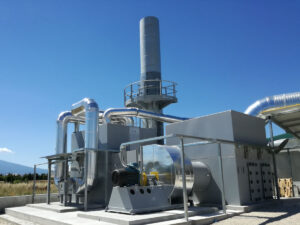
To solve the environmental issue characterized by extremely high airflow rates and relatively low pollutant concentrations, Brofind® combined two complementary technologies.
The first stage consists of a rotor concentrator system, which transfers pollutants from a very large airflow into a smaller concentrated stream. This process significantly reduces the air volume requiring final treatment while increasing VOC concentration.
The pollutant transfer occurs through a special adsorbent material capable of retaining VOCs and releasing them during the regeneration phase through controlled heating.
The concentrated emission is then treated by regenerative thermal oxidation (RTO), a technology particularly effective for VOC destruction.
Regenerative thermal oxidation converts organic pollutants into compounds with lower environmental impact, mainly water vapor and carbon dioxide. Since oxidation reactions require temperatures between 800°C and 900°C, the system integrates high-efficiency ceramic heat recovery media capable of minimizing auxiliary fuel consumption.
Rotoconcentration is a process frequently used for the treatment of atmospheric emissions containing vocs released in industrial painting processes, characterized by the need to treat high air flows and reduced quantities of pollutants; it is not a final treatment, for which it must be combined with another technology: in this case, it has been combined with regenerative thermal oxidation, which completes the purification of the concentrated emission.
The application in the naval industry had to foresee the identification and application of specific measures aimed at enabling the following goals:
- The achievement of the highest purification performances, through a specific sizing of the process parameters.
- The optimization of energy consumption, thanks to the combination of multiple technologies, aimed at allowing the treatment of high air flow rates with reduced quantities of pollutants.
- The ability to resist any dirtying and clogging phenomena caused by the presence, in the emission, of organic dusts resulting from the overspray produced in the painting process.
- Plant durability over time, through the use of resistant materials and components in the presence of marine environments.
The results achieved
The results obtained thanks to the combination of these technologies confirms the efficiency of the solution that has allowed us to achieve the following goals:
- The disappearance of olfactory harassment and the consequent effects on the surrounding environment.
- The achievement of concentration values of pollutants emitted into the atmosphere significantly lower than the prescribed regulatory limits.
- The reduction of the formation of secondary pollutants.
- The containment of management costs.
- No interference with the production processes upstream of the purification plant.
The integrated solution confirms the effectiveness of advanced technologies for the treatment of naval painting VOC emissions in large-scale industrial applications.