- The environmental impact of polydiene finishing processes.
- Emissions characteristics.
- Depuration goals
- The solution through the process of regenerative thermal oxidation, preceded by wet abatement.
- The measures identified for the application in the industry of polydiene finishing.
- The results
- Go to the gallery with all our systems
Industrial VOC removal and dust suppression in polydiene production
Our customer is a petrochemical company which manages the activity of the styrenes & elastomers, polyethylene, and basic chemical business areas, coordinating the production and marketing of the entire product portfolio through its three divisions.
The environmental impact of polydiene finishing processes.
Industrial VOC removal is a critical challenge in petrochemical manufacturing processes, especially in polydiene finishing lines where atmospheric emissions may contain volatile organic compounds (VOCs), polybutadiene rubber fine particles, and calcium stearate dust.
Our customer is a petrochemical company operating in the styrenes & elastomers, polyethylene, and basic chemicals sectors, coordinating the production and commercialization of its product portfolio through three dedicated divisions.
Emissions characteristics.
Air emissions from polydiene finishing processes have the following characteristics:
| VARIABLE | CHARACTERISTICS |
|---|---|
| Temperature | 30-80°C |
| Humidity | 40-100% |
| Presence of volatile organic compounds (V.O.C) | N-hexane |
| Presence of dusts in the emission to be treated | 0,5-1 g/Nm3 |
| Emission flow rate | 50.000 Nm3/h |
| Operational cycle | Continuous |
| Variability | Limited |
Depuration goals
The main depuration objective is to minimize the emission of pollutants harmful to the environment, particularly VOCs and dust.
According to the US EPA, VOC emissions can significantly impact air quality and industrial environmental compliance.
Dust reduction is especially important because excessive particulate matter may interfere with downstream abatement systems. For this reason, the integration of an industrial VOC removal solution combined with wet dust suppression becomes essential to ensure operational continuity and high purification efficiency.
The solution through the process of regenerative thermal oxidation, preceded by wet abatement.
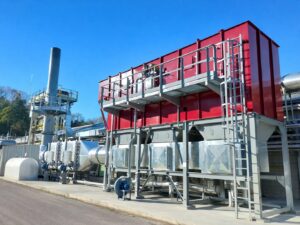
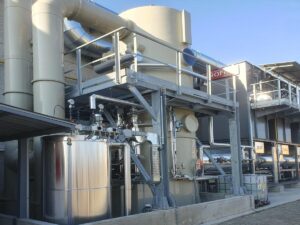
In order to solve the environmental issue, marked by emissions with almost continuous air flow and considerable mass flows of pollutants, it was installed a regenerative thermal oxidation plant preceded by a section of wet dust abatement.
The measures identified for the application in the industry of polydiene finishing.
Regenerative thermal oxidation is frequently used to treat atmospheric emissions containing V.O.C.; as the presence of dust can cause clogging of the ceramic masses, a wet de-dusting section has been added.
The application in the polydiene finishing industry had to involve the identification and application of specific measures aimed at achieving the following objectives:
- The achievement of the highest purification performance, through a specific sizing of the process parameters and the use of reversing valves with rapid handling and perfect seal
- The optimization of the energy consumption, thanks to the use of a special burner able to reduce the secondary pollutants produced by the oxidation process
- The use of a wet de-dusting section, suitable for dust control and to treat emissions with high dust content without clogging, and in the presence of high humidity
- The use of materials resistant to high operating pressures and corrosion phenomena
- The presence of an analyzer for the continuous monitoring of the pollutants emitted in the stack
The results
The results achieved thanks to the combination of these technologies confirm the effectiveness of the solution, which allowed the accomplishment of the following results:
- The achievement of values of concentration of pollutants in atmospheric emissions far below the regulatory limits required
- The minimization of energy consumption
- The absence of clogging phenomena, both in the oxidation and in the de-dusting section
- No interference with the production processes upstream of the treatment plant