For a leading international company in the production of pultruded profiles and centrifuged fiberglass poles, Brofind® has created an innovative abatement system for VOC emissions, specifically styrene.
The client profile: manufacturer of thermosetting profiles
The client where the plant described in this Case History was installed is a multinational company and a leader in the production of pultruded profiles and centrifuged fiberglass poles. The client’s production is characterized by two transformation processes:
- Pultrusion: A continuous, automated, and highly efficient process for the production of constant-section profiles with high mechanical properties (in the direction of the stress).
- Centrifugation: A batch process, patented by the client, used to create poles for lighting, power, and telephone lines.
Production processes: thermosetting plastics
In the production of the described artifacts, the company uses different classes of thermosetting polymers to adapt the product to various operating environments. These include:
- Polyester (Standard and Self-extinguishing): The preferred choice for general applications, offering an excellent performance-to-cost ratio. Self-extinguishing versions are enriched with additives (halogenated or halogen-free) to limit flame propagation.
- Vinylester: Resin types used where superior resistance to chemical corrosion and oxidizing agents is required, for example, in the electroplating industry, water treatment plants, and cooling towers.
- Epoxy: Reserved for applications requiring extremely high mechanical and dielectric performance. Epoxy profiles boast exceptional creep and fatigue resistance, making them ideal for components in the energy and aerospace sectors.
- Acrylic: Used due to its excellent reaction to fire and very low emission of toxic fumes, typical requirements for sectors such as railways and tunnel construction.
Abatement objectives: high air volumes to treat, low styrene concentrations, total reliability
The client selected Brofind® as a supplier to solve a specific problem linked to their processing cycles, during which emissions containing styrene (also known as phenylethylene or vinylbenzene) are released into the atmosphere. Styrene is an oily, flammable, water-insoluble liquid with a sweetish odor that belongs to the category of aromatic hydrocarbons, widely used in the industrial sector.
Styrene
Styrene is considered an environmental pollutant and an occupational hazard, classified by the IARC in Group 2A (probably carcinogenic to humans) due to its environmental behavior and related health effects. Styrene evaporates easily (high vapor pressure) and causes health effects linked to acute exposure, such as mucous membrane irritation and central nervous system depression (“styrene sickness”: headache, dizziness, fatigue), while chronic exposure is associated with neurotoxicity and potential genotoxic effects. For these reasons, and also to avoid possible olfactory nuisances, emissions containing styrene must be treated and abated as effectively as possible.
The Emission Profile
As a further element of complexity, the type of extraction and the extent of the production lines present on the site (over 12,000 m²) configure an emission profile characterized by very high air volumes to be treated, very low inlet pollutant concentrations, and a very high reliability requirement (uptime >99%).
Brofind’s design: rotoconcentrator and electric RTO for minimum environmental impact
For the reasons described above, Brofind opted for a solution design based on:
- Adoption of a rotoconcentrator.
- Coupling with a Regenerative Thermal Oxidizer (RTO).
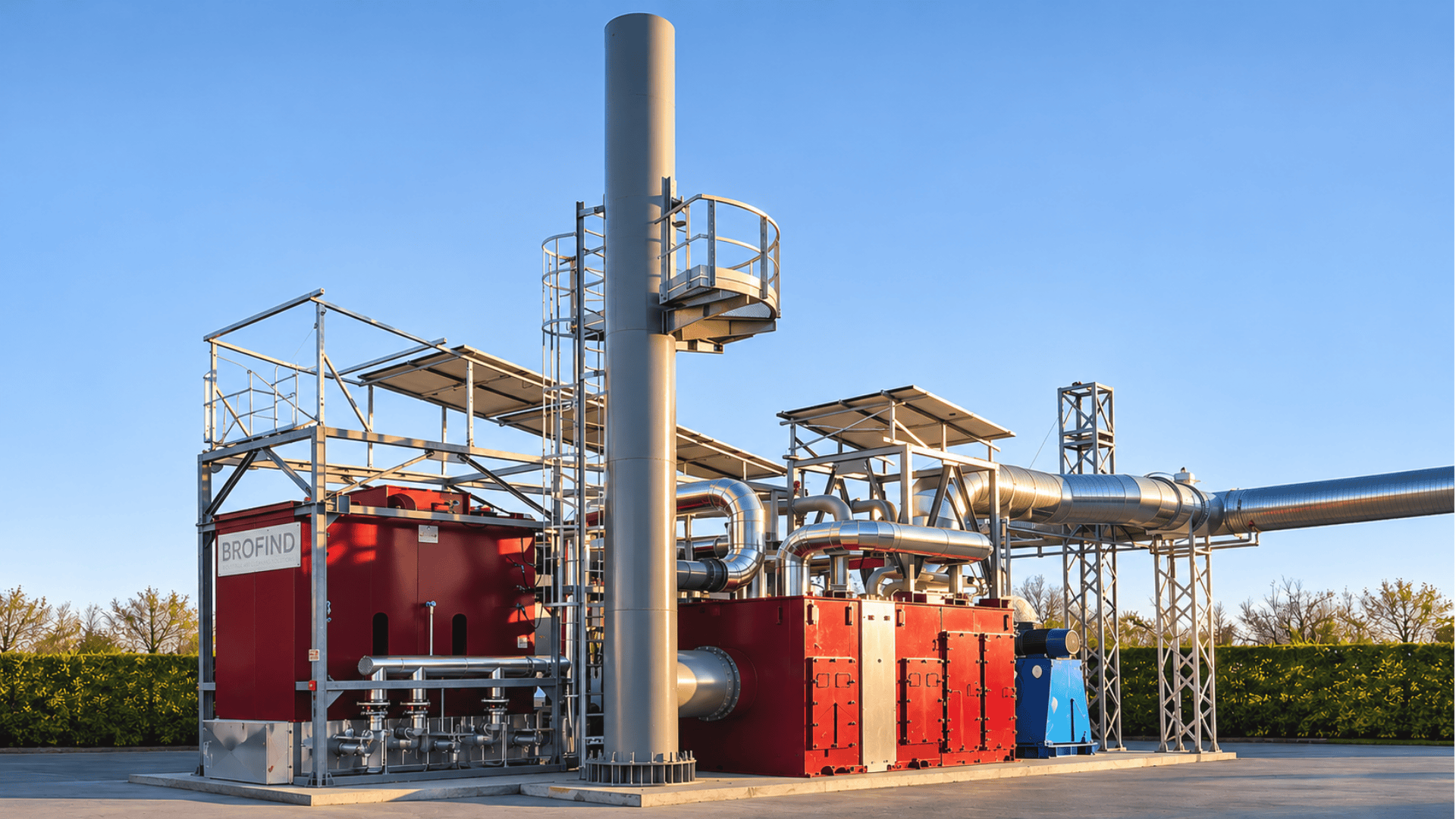
This choice made it possible to increase solvent concentrations during the treatment phase to achieve self-sustenance of the combustion reaction, thereby eliminating related energy consumption. Furthermore, considering the characteristics of the client—a multinational company and a pioneer in the plastics sector regarding ESG policies (the company performs in-depth Life Cycle Assessment (LCA) tests on its products and publishes an Environmental Product Declaration)—Brofind pushed its technical proposal further to accommodate these demands, proposing the use of Eco2 technology to eliminate the use of fossil fuels. Eco2 is an innovative product designed specifically to respond to growing market demand; it requires no gas connection and produces no CO₂, as it is based on the exploitation of electrical energy extracted from photovoltaic cells.
The Implemented R&D Solutions
The plant described above was further customized by Brofind’s R&D department with the introduction of:
- In-depth study of the resistor layout in the chamber, with fluid dynamic (CFD) and thermodynamic modeling (temperature profile at various points in the chamber).
- Full-electric combustion chamber heating system, with special resistors for the complete oxidation of styrene.
- Optimization and temperature control via SCR to modulate the power delivered by the resistors.
- Solar power supply for the entire system.
- Highly efficient thermal recovery section.
Concrete results: high performance, great reliability, and very limited carbon footprint
The specific objectives of the project were:
- High abatement performance.
- Reduction of the plant’s CO₂ emissions (ESG targets).
- Plant reliability (>99%).
In terms of performance, the client’s production processes, characterized by large air volumes and low pollutant concentrations, led to the choice of rotoconcentration solutions combined with electric regenerative thermal oxidation, enriched with the customizations necessary to reach the required abatement targets.
From a carbon footprint perspective, the decision to adopt Eco2 technology yielded excellent results: considering an operation over 3 shifts, 6 days a week, it allowed for an emission saving of approximately 130 tons/year of CO₂ compared to the use of a natural gas burner.
The client’s demand for extremely high reliability (uptime >99%) was also guaranteed thanks to R&D activities in analysis and solution customization.
In conclusion, Brofind designed and installed the first industrial air purification plant for electrical VOC abatement, featuring solar contribution and zero CO₂ emissions.
